
Headhunter · Executive search and direct approach in French-speaking Switzerland
Complicated watchmaking happens in the Vallée de Joux. Complicated hires: let’s solve them together.
The executives, experts and leaders your company can’t find on its own, approached one by one. You follow the search in a portal.
Executive search since 2005 · Cantonal and federal recruitment licences · Le Brassus, Vallée de Joux
First R&D, deep tech and watchmaking engineering. Also company leadership and IT experts. French-speaking Switzerland and Europe.


I’m the right recruiter in any of these cases:
This role is new to you
Nobody in-house knows what this profile looks like.
The profile seems impossible to find
It’s a niche area of expertise: these people don’t read your job ads.
The role has been open for months
The applications you receive don’t fit, and the team is waiting.
And in every case, we build it together. You get involved, and you understand your market.
A portal for working together.
Where do we stand? What’s happening this week? Who does what? We see it together, in one place.
Your say before anyone is approached, if you wish
In a niche, everyone knows everyone: people will soon work out that it’s you. So you can approve who is approached, in a secure space. Sometimes we even make the call together.
The same view for everyone
You, the colleagues involved and I can all see where the search stands and what each of us needs to do.
Hosted in Switzerland, files and CVs in the European Union. Included in the assignment.
Book a video call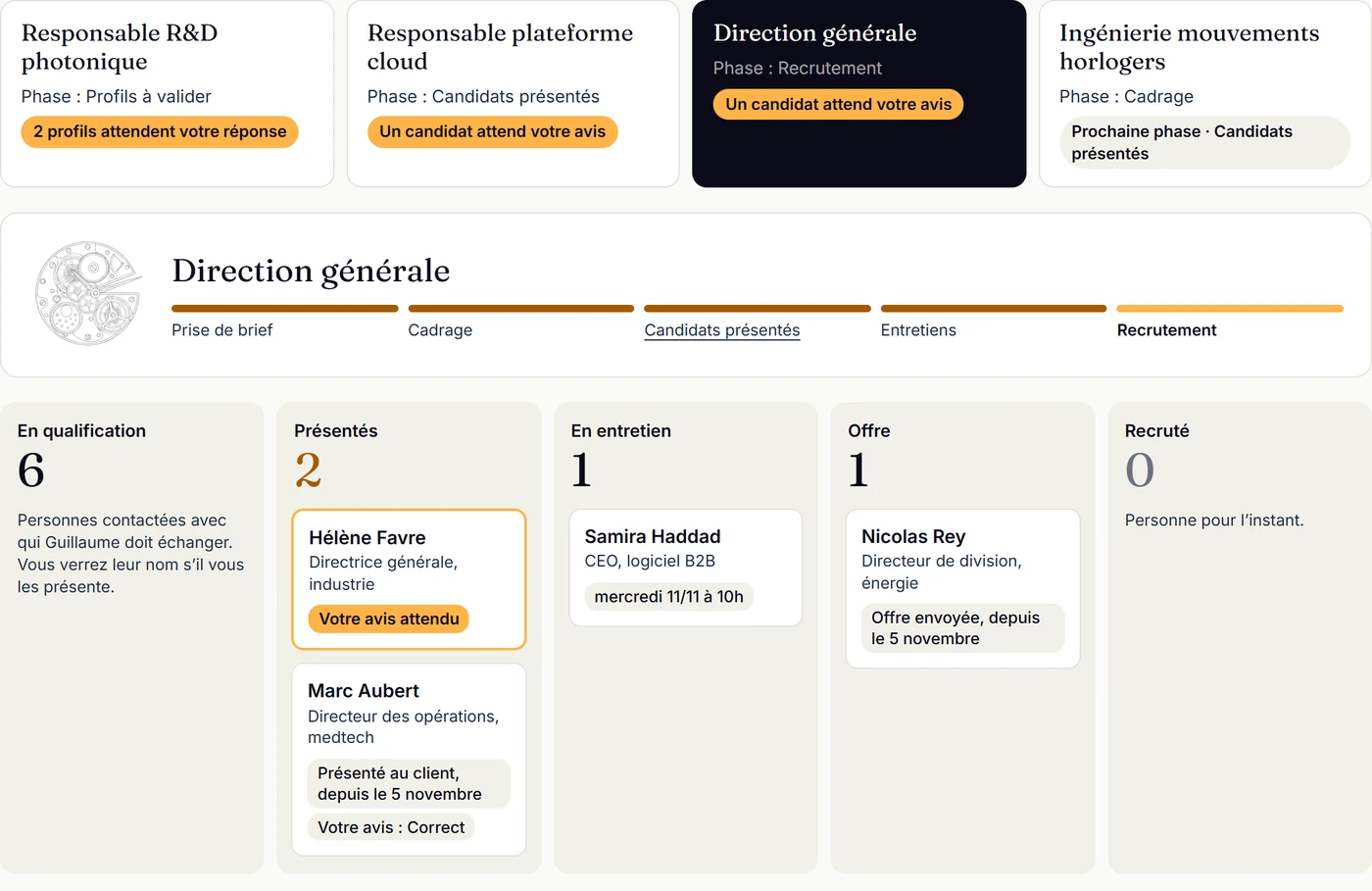
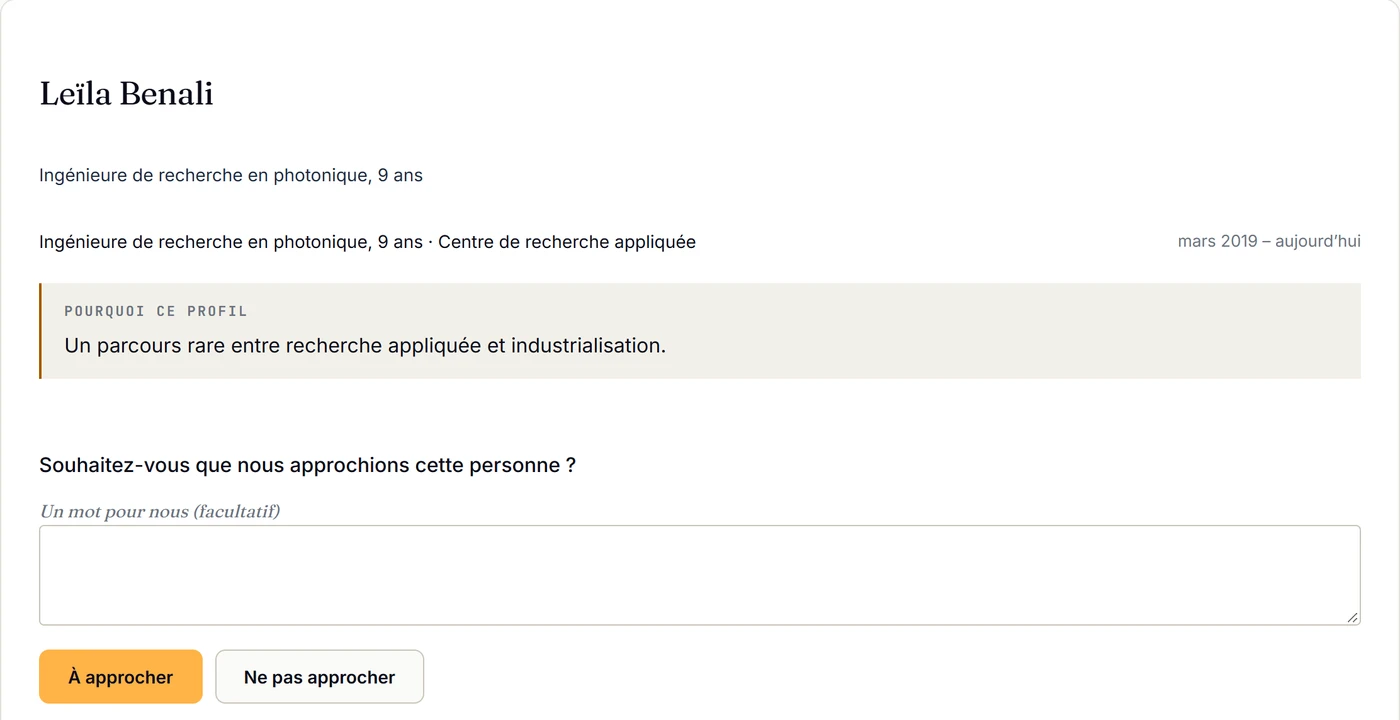
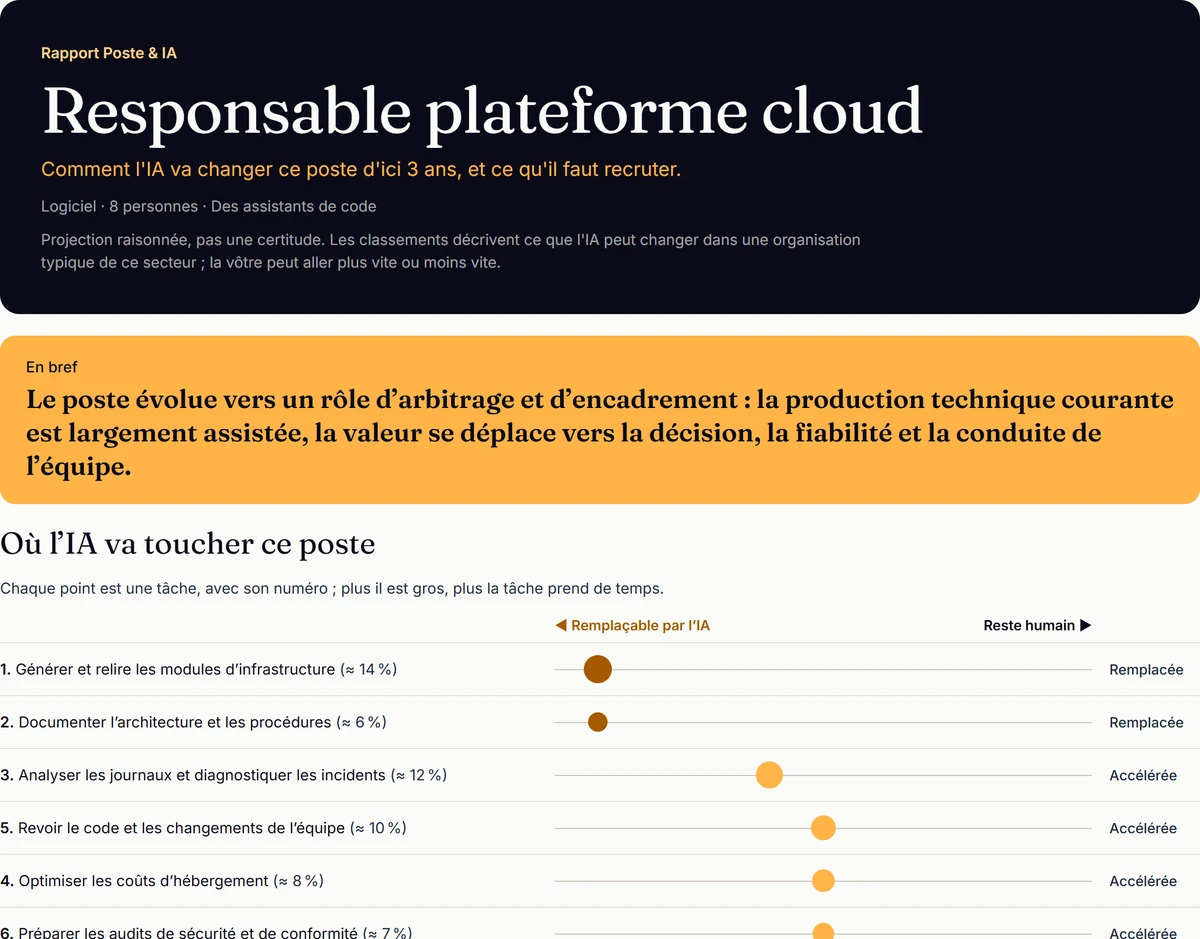
Demo assignment, fictitious data.
Before we contact anyone, we analyse the market.
Your challenge
- What’s holding you back today?
- What can’t the company do without this person?
- What will they need to change?
Market analysis
- Which companies should we target?
- Which job titles?
- How large is the target population?
- Who else is hiring right now?
Figures to decide who to look for, where, and whether to widen the search.
A hire is assembled.
Start from a good brief, test it against the market, talk to people, adjust. The goal: the best person to move the company forward.
-
Together
The brief
The cornerstone.
Before talking about the role, we understand your need and the business problem behind this hire: what’s holding you back today, what the company can’t do without this person. The role, and what we’ll assess, follow from that.
-
By me
The research
The data on your market is gathered and sorted: who does this job, in which companies, under which job titles.
-
Together
The market analysis
Talent intelligence, in plain terms.
The companies to target, the job titles, the size of the population, who else is hiring right now. A document with figures that you keep, discussed in a meeting. We adjust or widen the search.
-
Together
The fine-tuning
With the colleagues involved, we test the brief against what the market says. You have your say before anyone is approached, if you wish.
-
By me
The direct approach
People are approached one by one. The work is done transparently and together.
-
By me
My assessment
Against the grid we defined together at the brief: factual, with as little bias as possible, repeatable.
-
By you
Your interviews
You meet the people, with the prepared questions next to the CV.
-
By you
The final hire
You decide.
In the background, until signature
I stay in touch with each person.
What they think, what makes them hesitate. The relationship isn’t lost along the way.
Data can be found. Convincing people to join is human.
I started as a headhunter in 2005. Since then, I’ve been seeking out people who aren’t looking for a job, and I talk to them myself.
- Companies
- Job titles
- Available professional data
- Publications
- Co-authors
- Network and referrals
A sourcer and his machines, to go beyond what a human can do
Gathering the public data of an entire market. Protecting private data: profiles and CVs only go through tools I build, with strict rules.

The human, wherever the relationship matters
Understanding your need, convincing someone to make a move, and supporting them through to signature.
Two AI tools, included in the assignment.
One to look for the right people, the other to assess them with as little bias as possible.
Before the search
Will this role be the same in 3 years?
From your job description, the tool estimates, based on published research, which tasks AI is likely to transform within 3 years. This way we check that we’re looking for the right people: those the role will still need tomorrow.
Published method, six sources, including Science and the ILO. A reasoned projection, not a certainty.
When it’s time to assess
The scorecard: the right questions, on the right skills.
Once we know what to focus on, we choose together the skills that matter for this role. The scorecard turns them into the questions to ask in interviews: the same for each person, scored on the same grid. You find them in the portal, next to the CV, so you can take notes during the interview.
Tell me about a difficult decision you had to defend to your senior management.
Why structured interviews?
When each person answers the same questions and is scored on the same criteria, we compare answers, not impressions. According to research*, it is one of the most reliable ways to assess someone, and the one that leaves the least room for bias.
* Schmidt, Oh and Shaffer (2016), update of the Schmidt and Hunter meta-analysis: a hundred years of research on selection methods. Structured interviews rank among the best predictors of job performance.
Three assignments at a time, no more.
Real in-depth work takes time and commitment.
Most of my clients are confidential. Those who agree to be named are on the home page.
- 3assignments in parallel, never more
- 10 yrsthat some clients keep coming back
- 2005first year of direct approach
- 1only sourcer outside the US on Reality Labs’ advanced research (Meta)
An address book, or a method?
If you want someone who has personally known every candidate for twenty-five years, that isn’t me, and I won’t pretend otherwise. If you want the right person, including where nobody has looked yet, here is what you get.
- Sourcing as the foundation: 350+ sourcers trained since 2019 at some of the world’s most demanding companies, with The People Attraction Theory; training delivered several times for the Executive Research Association in the UK; the Sourcing Summit Red Shoes Award.
- A present-day search: the data of an entire market gathered and analysed, with tools built for the job.
- Your systems, your management and business stakes understood before searching for anyone, and the solution built with you.
- AI to go further into the data, and time spent with people above all, until the right person is hired.
- Quantum computing
Experimental physicists for Alice & Bob
Superconducting qubits: a small worldwide population, mapped from publications and their co-authors, then approached lab by lab. The roles were filled.
- Luxury and watchmaking
Interviews in Geneva without knowing the brand
High confidentiality: candidates landed in Geneva without knowing whom they were going to meet. I searched for the profile without ever knowing why the house needed it: everything happened between the company and the candidates. The person chosen walked out convinced, the role was filled, and everyone was delighted.
- International organisation
An SAP Director for the United Nations, in a conflict zone
A role nobody applies for: the person was found, convinced and hired for the roll-out of the information system.
Fees in three stages.
A percentage of salary, fixed when we sign our agreement, which doesn’t change afterwards. We discuss it in our first conversation.
- Delivery of the market analysis, a document you keep.
- Presentation of the candidates, with their written consent.
- Signature by the person you hire.
6-month guarantee
If the person doesn’t stay, I restart the search at no extra fee, once.
12 months without approaching this team or this function
I don’t recruit from it for any other client.
Exclusivity
A single firm on the role. Your job ads and employee referrals carry on.
Your questions.
What is the direct approach?
I contact people who are already in a job and don’t read job ads, and I introduce you to those who want an interview. It’s also called headhunting, or executive search.
How many assignments do you run at the same time?
Three at most, so that I stay personally on every search, from brief to signature. When they are taken, I tell you and we set a start date.
Can you name your clients?
Most are confidential, by contract or by prudence: in a niche, everyone knows everyone. Those who agree to be named are on the site’s home page.
What’s your complicated hire?
I reply myself: my reading of the role, my fees, and if I’m not the right person, I’ll tell you.
Or write to me using the form below: I’ll reply within 2 working days.
guillaume@gates-solutions.com+41 79 962 41 92
Got it. I'll get back to you soon.
If it is urgent, you can also email guillaume@gates-solutions.com or call +41 79 962 41 92.